
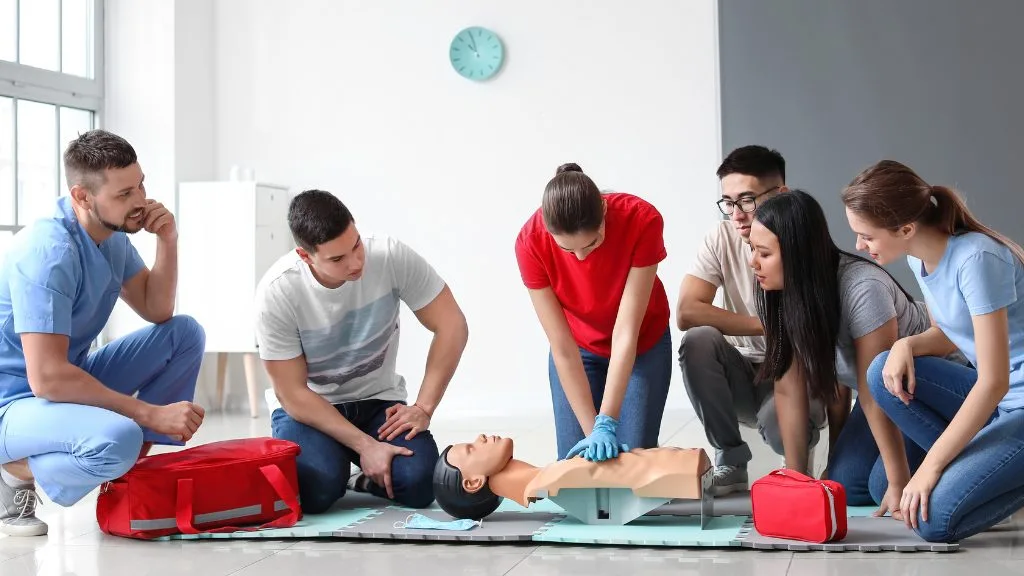
For dog owners living on acreages or walking rural routes outside Saskatoon, emergency readiness has to cover the humans in the situation first, since a dog cannot call for help, drive to a clinic, or perform CPR on the person it depends on. That distinction matters because rural life around Saskatoon and communities like Warman often means longer drives to both veterinary and human medical care, and the person walking the dog is frequently the only responder available if something goes wrong on the trail, the acreage, or the road.
Key Takeaways
- Rural dog owners are often far from both emergency medical services and veterinary clinics, making basic human first aid knowledge a practical safety layer for the whole family.
- Common rural risks, falls on uneven ground, livestock encounters, road incidents on unlit rural roads, affect the human end of the leash as much as the dog.
- First Aid training near Warman gives acreage owners and rural dog walkers hands-on skills for the human emergencies that are statistically more likely to occur.
- An online Pet First Aid option exists for owners who want to extend their preparedness to their dog as well, without requiring in-person attendance.
- With over 21,000 Google reviews and more than 19,000 rated five stars, established first aid providers in Saskatchewan offer a track record rural families can review before booking.
Why Should Dog Owners Think About Human First Aid at All?
It’s easy to focus safety planning entirely on the dog, a first aid kit for paw injuries, tick removal tools, an emergency vet number, while overlooking that the person holding the leash faces their own set of risks. A fall on icy ground while walking a dog, a twisted ankle on an uneven trail, or a sudden medical event like a cardiac episode can leave a dog owner needing help just as urgently as the dog might. Because dogs cannot dial for assistance, the owner’s own first aid knowledge, or a nearby neighbor’s, becomes the actual safety net. Rural dog walking routes, often chosen precisely because they are quiet and remote, are also the routes where help takes longest to arrive.
How Does Distance From EMS Change the Risk Calculation for Acreage Owners?
Acreage properties and rural routes around Saskatoon and Warman commonly sit well outside the response radius that urban residents take for granted, sometimes twenty minutes or more from the nearest ambulance dispatch point. That gap means an injury that would be minor in the city, a bad fall, a deep cut from fencing or farm equipment, can become far more serious if the person involved does not know how to manage bleeding or shock while waiting. Basic first aid training addresses this gap by teaching people to stabilize themselves or a companion until transport arrives. For families managing livestock, machinery, and long driveways, this kind of preparedness tends to matter more, not less, than it does in town.
What Are the Most Common Emergencies Rural Dog Owners Actually Face?
Beyond the dog-specific risks most owners already plan for, rural life introduces human-focused risks worth naming directly: falls on uneven or icy terrain during walks, road incidents on unlit rural roads at dawn or dusk when many people walk dogs, and encounters with livestock or wildlife that can startle both dog and owner. None of these are dog first aid problems, they are human first aid problems that happen to occur while a dog is present. Training that covers wound care, fracture stabilization, and CPR gives rural dog owners a practical response to incidents likely to occur on their own property or walking route.
Does Pet First Aid Training Have a Place in This Picture?
Yes, as a complement rather than a replacement. Human first aid remains the priority because it addresses the higher-stakes scenarios, but many providers also offer an online Pet First Aid option covering choking or bloat symptoms, basic wound care for a dog, and when a situation requires emergency veterinary transport. Completing Coast2Coast first aid and CPR training for the humans in the household first, then adding pet-focused knowledge afterward, gives a rural family layered coverage that respects both dependents. The combination reflects how rural households actually operate: one person often responsible for both the family’s safety and the animal’s.
How Should Rural Families in the Saskatoon Area Prioritize Their Training?
For most acreage owners and rural dog walkers, human first aid and CPR certification should come first, since it addresses the scenario where the owner is incapacitated and no one else may notice for some time. From there, an online pet first aid course adds a reasonable second layer for households with working or hunting breeds that spend significant time outdoors. Group or family bookings can make sense for households where multiple adults handle dog walking or farm chores independently. The goal is not to over-prepare but to close the specific gap that distance from EMS creates for rural residents.
FAQs
Why would a dog owner need human first aid training instead of just pet first aid?
Because the person walking or caring for the dog faces their own risks, falls, road incidents, medical events, and a dog cannot summon help, so the owner’s own preparedness is the more critical safety layer.
Is pet first aid training available separately from human first aid courses?
Yes, many providers offer an online Pet First Aid option that can be completed independently or alongside standard human first aid and CPR certification.
How much longer are rural EMS response times compared to city response times near Saskatoon?
Response times vary by location and service availability, but rural and acreage properties are generally farther from dispatch points than urban addresses, which is worth confirming with local emergency services directly.