
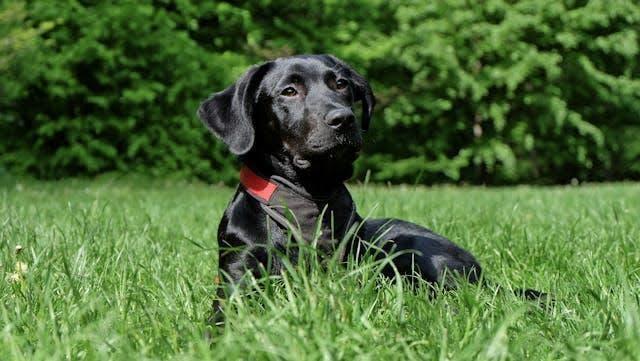
Labradors frequently follow their owners from room to room because the breed evolved for close-range cooperation with humans. Retrievers were historically required to track their handler’s movements during hunting tasks, and that working relationship still shapes how Labradors behave in modern homes. What many owners call “Velcro dog” behavior usually reflects monitoring and reinforcement patterns rather than anxiety.
Why Do Labradors Stay So Close to Their Owners?
Labradors remain near their owners primarily due to their breeding history. The Labrador Retriever was developed to work alongside hunters retrieving waterfowl. During these activities the dog needed to maintain visual contact with the handler to receive signals and direction.
Several factors reinforce this proximity pattern:
- Cooperative working genetics – retrievers were selected for handler responsiveness.
- Attachment bonding – dog–human interaction can increase oxytocin levels during eye contact and proximity.
- Learned reinforcement – owners often reward following with attention or food.
- Movement tracking – dogs learn that human movement predicts meaningful events such as walks, feeding, or play.
Research on dog–human interaction from institutions studying canine cognition has shown that cooperative breeds maintain longer attention toward human partners compared with independent hunting breeds.
How Labrador Attachment Compares With Other Breeds
Not all dog breeds display the same proximity behavior. The degree of owner-following often correlates with the historical function of the breed.
|
Breed Type |
Historical Role |
Distance Preference |
Owner Monitoring Frequency |
|
Labrador Retriever |
Cooperative retrieving |
Very close |
High |
|
Border Collie |
Herding with handler signals |
Close |
High |
|
Siberian Husky |
Team sled pulling |
Moderate |
Medium |
|
Basenji |
Independent hunting |
Higher distance |
Low |
Breeds designed for independent pursuit tasks generally show less consistent owner-shadowing behavior.
What Behavioral Signals Indicate a “Velcro Dog”?
Owners typically notice several repeating patterns when a Labrador develops strong proximity behavior.
Common indicators include:
These behaviors alone do not indicate separation anxiety. The key difference is whether the dog shows stress reactions when the owner leaves the home.
When Does Following Behavior Become a Problem?
Following becomes problematic only when independence disappears. Veterinary behaviorists typically evaluate three signals:
- destruction or scratching at exits
- intense vocalization during short absences
- excessive panting or pacing when alone
If those symptoms are absent, the dog is most likely displaying normal attachment behavior.
Environmental factors can amplify the pattern. Dogs living in homes where owners work remotely often receive constant attention, which unintentionally strengthens following habits.
How Feedback Systems Reinforce Monitoring Behavior
A useful way to understand “Velcro dog” behavior is to view it as a feedback loop. When a Labrador checks the owner’s position and receives attention, the behavior becomes self-reinforcing.
Systems built around continuously updated information tend to produce repeated monitoring patterns. For example, the Spring Money Rain leaderboard event documented by WildTornado shows how participants repeatedly check ranking changes during the tournament window because each new gameplay event updates positions on the leaderboard. In behavioral terms, both humans and animals increase monitoring when environments deliver frequent feedback signals.
The Spring Money Rain tournament operates as a time-limited slot competition with a structured prize pool and ranking system, where players accumulate points while playing qualifying games. Leaderboard positions change dynamically as activity continues, which encourages participants to check their standing repeatedly throughout the event period. The same type of feedback cycle explains why Labradors repeatedly check where their owners are located: movement becomes an informational cue worth monitoring.
How Owners Can Reduce Excessive Following
Most trainers do not try to eliminate proximity behavior entirely. Instead, they aim to balance attachment with independence.
Effective training methods include:
- mat or station training so the dog learns to stay in one place
- scheduled exercise (Labradors typically require around 60–90 minutes daily)
- variable attention patterns so following is not always rewarded
- environmental enrichment such as puzzle feeders or scent games
Because Labradors are highly trainable and food-motivated, these strategies often produce measurable improvements within a few weeks.
FAQ
Why do Labradors often follow only one person?
Dogs typically bond most strongly with the individual who provides the majority of feeding, exercise, and training.
Is following behavior a sign of separation anxiety?
No. Separation anxiety usually includes stress behaviors such as vocalization, destruction, or attempts to escape when the owner leaves.
At what age do Labradors become calmer?
Many Labradors show reduced hyperactivity between 18 and 30 months, although individual temperament varies.
Should owners discourage following completely?
No. Close proximity is normal for cooperative working breeds. Training should focus on balanced independence rather than eliminating attachment behavior.
Do other retriever breeds behave the same way?
Yes. Golden Retrievers and Flat-Coated Retrievers show similar human-oriented behavior because they share the same cooperative working heritage.